How Flow works
One job.
Enquiry to paid.
Not a feature list — a single piece of work moving through Flow, in the order it actually happens. At every stage: what arrives, what Flow has already done about it, and what is left for you.
The stages below are Flow’s real workflow stages, taken from the product’s own configuration — one workflow, and the same one whatever the business does. The Flow Trades workflow →
The enquiry
Someone needs a plumber. That is the only thing you can count on.
- What enters Flow
- A public enquiry form the customer fills in — with their own photos of the problem — or a call you take and note down.
- What Flow prepares
- The enquiry arrives as a job rather than a message to be retyped. The customer record, their photos and their words are already attached to it.
- What you do
- Read it, and decide whether it needs a look or can be quoted off the photos.
- What the job keeps
- The customer, the original words, and the photos they sent. Nothing is re-keyed, so nothing is lost in the re-keying.
It becomes a job at the enquiry stage, in the one workflow.
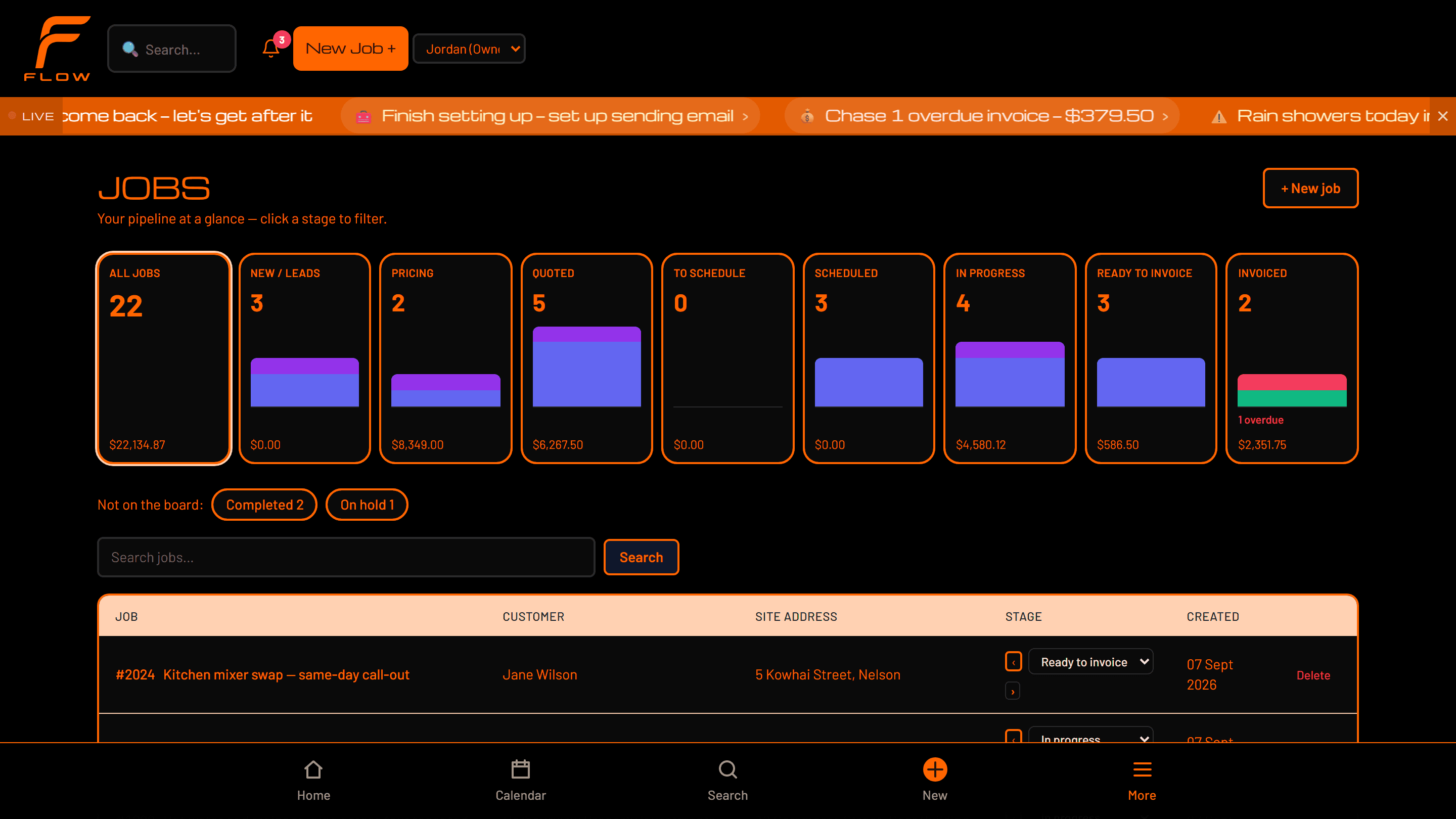
The site visit
For most real jobs, someone has to go and look.
- What enters Flow
- You, on site, with a phone. Photos, measurements, and — if you would rather talk than type — a voice note describing what the job actually involves.
- What Flow prepares
- The visit is written up from what you captured. Photos land against the job, not in your camera roll.
- What you do
- Look at the job. Talk through it. Take the photos you would have taken anyway.
- What the job keeps
- Site photos and fixture photos — the evidence the job needs before it can close, which Flow already knows to hold out for.
There is now enough to price it.
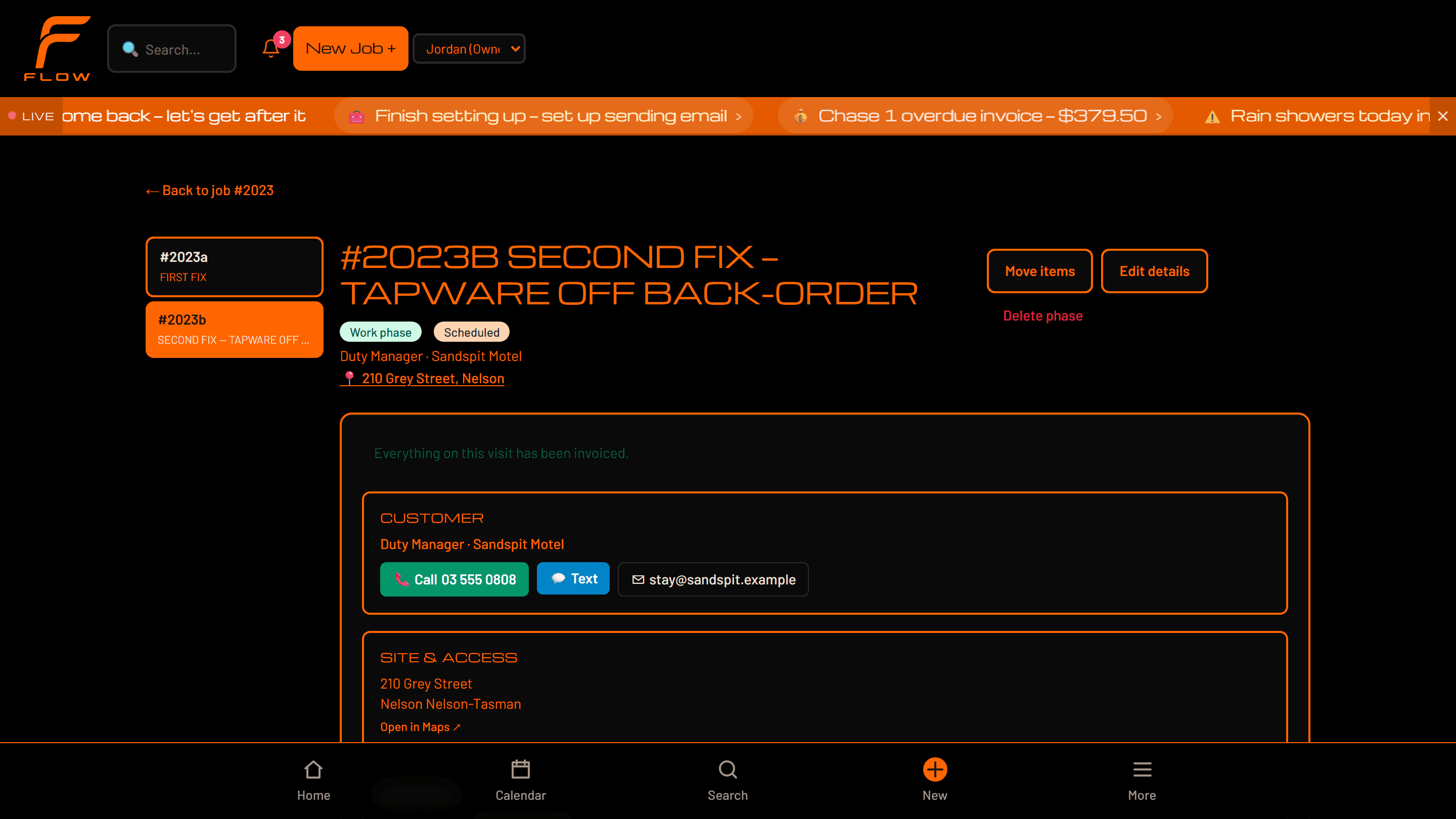
The quote
The stage that decides whether you win the work, usually done at night.
- What enters Flow
- What you said and saw on site, plus your own rates, materials and the kits you have set up.
- What Flow prepares
- A drafted quote in Flow's own sections — scope, materials, labour, exclusions — priced against your rates rather than a generic template.
- What you do
- Read it, change what you want, and send it. It does not go anywhere until you do.
- What the job keeps
- The quote against the job, with what was included and what was explicitly excluded.
It sits with the customer — and Flow starts watching it.
The customer says yes
Or, more often, says nothing for a fortnight.
- What enters Flow
- The customer's acceptance — or their silence.
- What Flow prepares
- If the quote goes quiet, the follow-up is written and waiting for you. This is the Sales agent's whole job, and it drafts rather than sends.
- What you do
- Approve the follow-up, or don't. Either way you did not have to remember the quote existed.
- What the job keeps
- The quote's state, and the fact that a nudge was drafted and what happened to it.
An accepted quote becomes work that has to fit in a week.
Scheduling
Fitting it in without breaking the rest of the week.
- What enters Flow
- The accepted job, your business hours, and the team you actually have.
- What Flow prepares
- Hours booked measured against the team available, so an overloaded week is visible before it happens. The confirmation to the customer for the day before is drafted and held.
- What you do
- Put it in the calendar and assign who is doing it.
- What the job keeps
- The booking, who is on it, and the confirmation waiting to go out.
The team needs to be able to actually use this on the day.
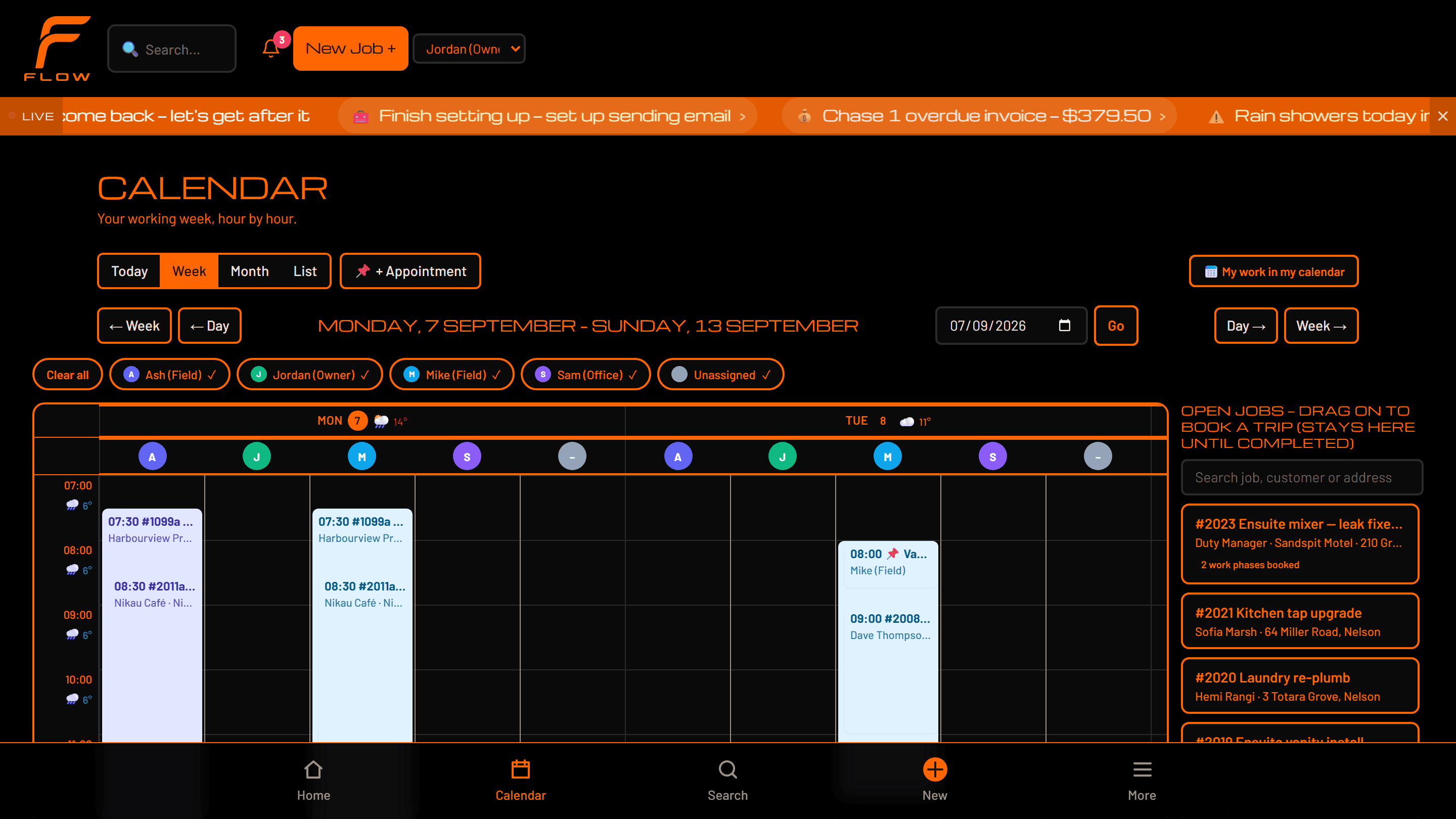
The team, on the job
The stage every job-management rollout dies at.
- What enters Flow
- An apprentice with a phone and a PIN. A big timer, the checklist, the photos, and the van stock.
- What Flow prepares
- The job already knows what it needs: which checks, which photos, which measurements. If the team is running late, the text to the customer is drafted before anyone has thought of it.
- What you do
- Tap the timer. Take the photos. Do the work.
- What the job keeps
- Time on the job, materials off the van, completion photos, and sign-off — all against this job rather than remembered for later.
The job has produced everything the invoice needs.
Evidence and compliance
Where a job either closes properly or comes back to bite you.
- What enters Flow
- The tests and records the work is required to produce, held against the job until they are there.
- What Flow prepares
- Flow knows what the job needs before it can close — the site photos, the readings, the sign-off — and it will not quietly let it through without them.
- What you do
- Do the test. Record it. Sign it off.
- What the job keeps
- The certificate and the evidence, attached to the job and searchable later when someone asks.
The work is finished. The money is not.
The invoice
The part most businesses do last, and worst.
- What enters Flow
- The time that was actually tracked, the materials that actually came off the van, and any supplier bill that landed against the job.
- What Flow prepares
- The invoice is built from real time and materials rather than from memory on a Sunday. Supplier bills read themselves into the job's costs on the way in.
- What you do
- Check it and send it. It pushes to Xero, so your accountant stays where they already work.
- What the job keeps
- What the job cost, what it earned, and the invoice's own state.
It is sent. Now it has to actually get paid.
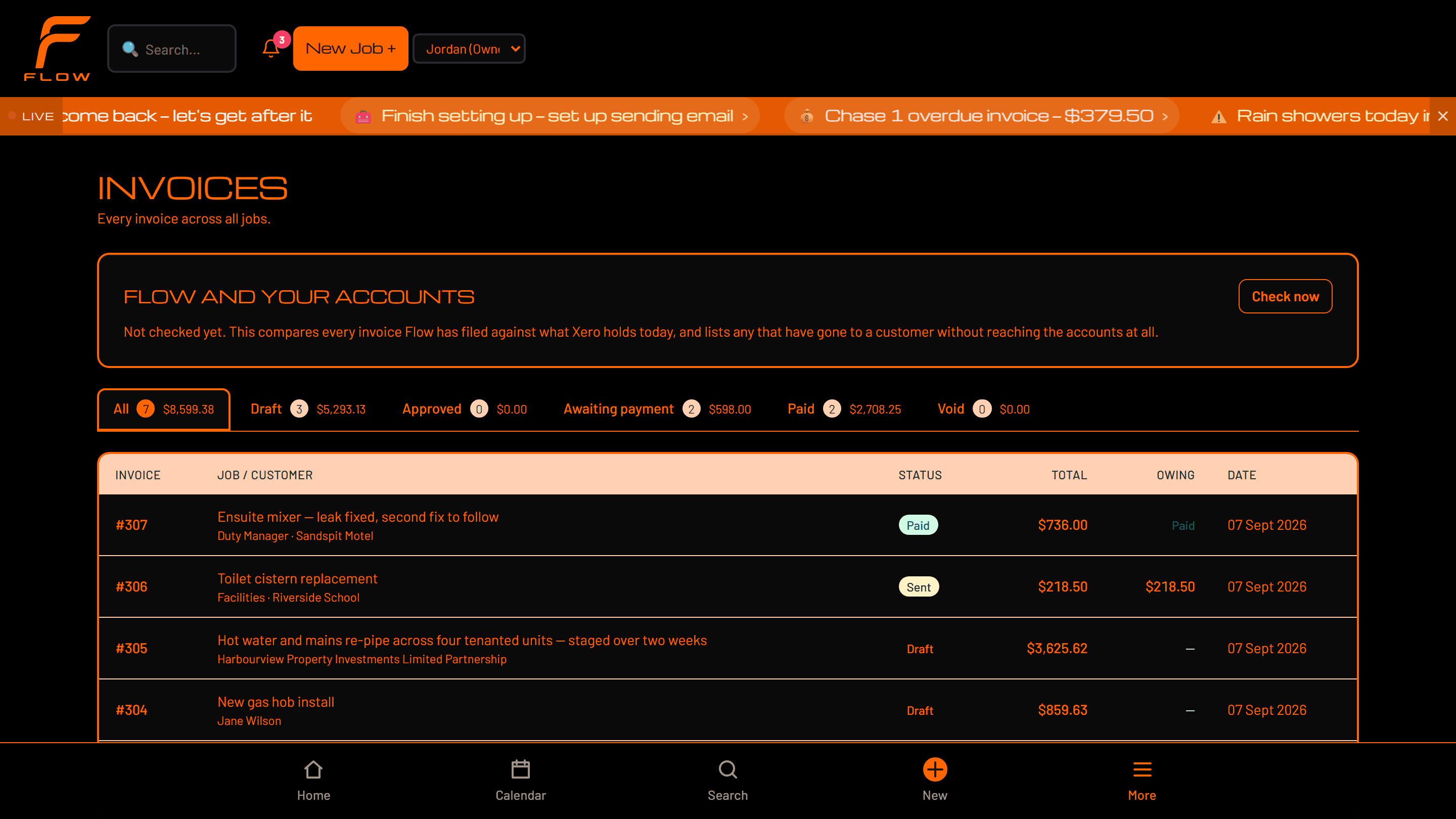
Getting paid, and what Flow noticed
The admin tail — and the reason the pile used to build up.
- What enters Flow
- Time passing, which is the thing no one is watching.
- What Flow prepares
- An overdue invoice gets a reminder drafted per debtor. A finished job gets a thank-you or a review ask. Quiet customers get a re-engage message. All of it waiting for you, none of it sent on its own.
- What you do
- Read the queue. Approve what should go. That is the whole evening's admin.
- What the job keeps
- A record of everything Flow did on your behalf, written down so you can check it afterwards rather than an alert you dismiss.
Nothing. That is the point — there is no pile left at the end of it.
9 stages, and you typed the job in exactly zero times
That is the whole argument. Every other system gives you somewhere to put the admin, and the admin still has to be put there by a person — usually the same person, usually at night.
The intelligence doing the preparing at each stage is Motion, and it is the same product at the same price. How Flow thinks and prepares work →
Do this with one of your own jobs
Twenty minutes. Bring a real one — ideally the messy one you are dreading — and we will take it from enquiry to invoice while you watch.